Case Studies

Real-world SAP digital transformations, factory automation, and enterprise execution.

Case Study 1 Automotive Supplier SAP MII / MES
October 2025

Enterprise Integration & Manufacturing Execution: Global Automotive Leader

Executive Summary

A European multinational technology leader in cold forging and vehicle steering systems, headquartered in Liechtenstein with over 20 operational locations globally, embarked on an extensive digital manufacturing transformation. To stay competitive in an increasingly automated sector, the enterprise needed to bridge the widening gap between machine-level production and executive IT systems.

Business Challenges

The client's operational landscape was hampered by fragmented legacy systems. In the absence of a unified Manufacturing Execution System (MES), plant operators relied on disparate software interfaces, manual adjustments, and fragmented paper trails. This lack of integration created operational silos with competing "versions of the truth," leaving leadership with non-scalable reporting managed almost entirely by hand.

Furthermore, the existing data infrastructure depended on historical, stagnant records rather than live telemetric feeds, making root-cause analysis slow and reactive. To modernize its operations, the company set an ambitious goal: implement a future-oriented Industry 4.0 architecture powered by the SAP Leonardo stack to connect approximately 1,500 machines across 13 global plants for IoT scenarios and predictive maintenance. Delivering this vision required balancing agile development sprints with structured waterfall deployment methodologies to ensure zero production downtime across facilities.

The Architecture & Resolution

The strategic solution focused on dismantling operational silos by establishing a direct connection between the shop floor and executive leadership. By standardizing processes and IT systems, the organization established a single, trustworthy version of truth for all operational data.

  • Machine Integration Layer: Deployed SCADA, PLC, and OPC-UA communication protocols to establish reliable machine-level data capture across 1,500 production assets.
  • Manufacturing Execution Layer: Leveraged SAP MII and SAP ME alongside SAP Edge Services to handle localized shop-floor logic, telemetry buffering, and operational execution with low latency.
  • Enterprise Intelligence & Analytics Layer: Consolidated operational KPIs into SAP Analytics Cloud powered by SAP HANA, while routing massive streaming datasets into Apache Hadoop and Spark via SAP Big Data Services.

Business Impact & Value Delivered

The deployment delivered an edge-to-enterprise integration framework that funnels continuous asset telemetry straight to plant managers and data analysts. Plant decision-makers gained near-real-time visibility through live SAP reporting dashboards, replacing manual reconciliations and enabling proactive adjustments before production bottlenecks occur.

Additionally, the integration simplified complex big data analytics. By structuring high-throughput manufacturing data using Hadoop tools within SAP Big Data Services, the engineering and data science teams can now seamlessly run predictive maintenance algorithms to anticipate machine failure and optimize equipment utilization across all 13 international facilities.
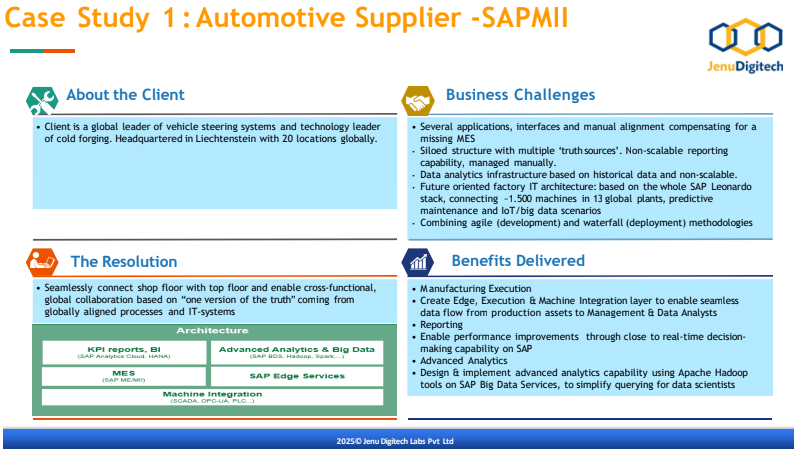
Case Study 1 Automotive Supplier SAP MII Architecture Diagram
Case Study 3 Speciality Chemicals SAP IBP
November 2025

Global Specialty Chemicals Leader: End-to-End Supply Chain Orchestration with SAP IBP

Executive Summary

A premier multinational specialty chemicals corporation headquartered in Louisiana, delivering cutting-edge chemical solutions across more than 100 countries globally, initiated an enterprise-wide planning overhaul. Operating in a dynamic, capital-intensive industry with fluctuating feedstock costs and complex global distribution networks, the organization sought to modernize its planning ecosystem to achieve agile decision-making, tighter inventory control, and synchronized cross-functional operations.

Business Challenges

The enterprise faced escalating challenges in managing working capital and inventory health across its sprawling global footprint. Fragmented regional planning models and reliance on disconnected, stand-alone spreadsheet environments made it difficult to gain holistic visibility into inventory projections or production capacity.

  • Working Capital Optimization: Needing tighter control over tied-up capital through synchronized inventory policies across multiple tiers of manufacturing and distribution.
  • Global S&OP Standardization: The absence of a formalized, sustainable Sales and Operations Planning (S&OP) cadence, resulting in disconnected regional practices and inconsistent supply-demand balancing.
  • Data Model Fragmentation: The lack of a unified planning data architecture capable of integrating disparate demand forecasts, production capacities, supply constraints, and financial targets into a coherent operational plan.

The Architecture & Resolution

To establish operational discipline and unified governance, the enterprise implemented SAP Integrated Business Planning (SAP IBP) for Sales and Operations, transitioning from manual planning sheets to an intelligent, automated planning cloud.

  • Unified S&OP Governance & Collaboration: Leveraged SAP IBP for S&OP to foster cross-departmental collaboration, establishing structured workflow routines that align sales commitments directly with operations and financial plans.
  • Multi-Echelon Inventory Planning: Configured multi-tier supply network models to plan, position, and project inventory buffers across raw materials, chemical intermediates, and finished goods, directly boosting customer order fulfillment rates.
  • Dynamic Scenario Simulation & What-If Analysis: Built advanced simulation environments allowing planners to model fluctuating market demand, supply disruptions, and feedstock pricing changes in real time before locking in operational production schedules.

Business Impact & Value Delivered

The deployment established a transparent, highly automated planning environment that significantly reduced working capital pressures and manual overhead.

  • End-to-End Visibility: Delivered crystal-clear visibility into asset utilization and forward-looking inventory projections across all raw materials, intermediate compounds, and finished products.
  • Higher Forecasting Accuracy: Transitioned from error-prone standalone spreadsheets to an automated central planning platform, generating superior statistical forecasting outputs and robust demand-supply alignment.
  • Planner Efficiency & Error Reduction: Eliminated manual reconciliation cycles, drastically reducing human error, accelerating monthly consensus S&OP cycle times, and empowering planners to focus on high-value strategic optimization.
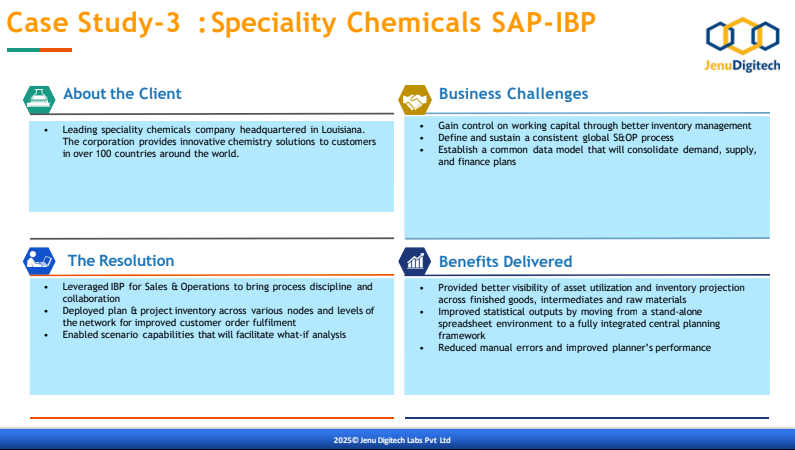
Case Study 3 Specialty Chemicals SAP IBP Architecture Diagram